Quantum technologies and New Space: towards safer, more precise and autonomous space systems
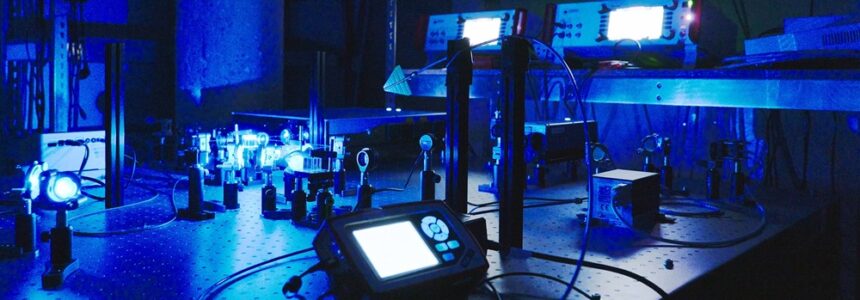
If the first quantum revolution gave us inventions such as the laser and the transistor, the second, which we are now experiencing, allows us to manipulate individual particles such as atoms or photons to perform tasks that were previously considered impossible.
At Gradiant, we see quantum technologies as a strategic and operational field that will transform security, defence and the aerospace sector. That is why we will be sharing our vision and latest developments at New Space España, the event bringing together the aerospace innovation ecosystem in Vigo on 24 and 25 September.
How will quantum technologies revolutionise the aerospace sector?
Secure quantum communications, precision sensing and advanced quantum computing are the three strategic pillars Gradiant is working on to overcome the limitations of conventional technologies in terms of performance, resilience and autonomy.
Secure communications: protecting information against the threat posed by quantum computing
The disruptive potential of large-scale quantum computing poses a major challenge to the confidentiality and security of communications. This is why one of our lines of work focuses on developing technologies capable of strengthening security against both current and future cybersecurity threats.
In this field, we develop QKD (Quantum Key Distribution) protocols. We combine our expertise in quantum information theory with advanced instrumentation and state-of-the-art detection systems to implement QKD protocols. These protocols enable the exchange of encryption keys whose security does not rely on mathematical complexity, as in classical cryptography, but on the immutable laws of quantum physics.
We also investigate new distributed multi-user network paradigms for key exchange that can overcome operational limitations in the face of potential denial-of-service attacks, with the aim of extending quantum-secure communications to a broader range of applications.
The work of Gradiant’s Quantum Technologies team also covers the development of the components and systems required to bring these communications into real-world scenarios: from emitters, detectors and photonic integrated circuits to architectures capable of connecting multiple users and progressively integrating with existing telecommunications networks.
Another challenge is extending the distance over which these communications can operate and increasing the rate at which new keys can be generated. To achieve this, we research technologies such as quantum repeaters, designed to store and distribute quantum information between different points in a network, and quantum memories, which can synchronise key generation across different branches of a multi-user network. These are key components in the development of future longer-range quantum communication networks.
Ultra-precision sensing: metrology beyond classical limits to navigate and understand the environment
Another area with significant innovation potential in the aerospace sector is quantum sensing, which harnesses the properties of matter and light to perform measurements with levels of sensitivity and precision that are difficult to achieve using conventional technologies.
At Gradiant, we work with different Advanced Sensing Platforms, including Rydberg atomic sensors and NV centres in diamond. These technologies can be used to accurately measure magnetic fields, temperature or electromagnetic signals, opening up new possibilities in areas such as navigation, Earth observation and environmental monitoring.
In this context, progress in resilient PNT (Positioning, Navigation and Timing) systems, which enable autonomous navigation in environments where GPS is unavailable or compromised, is particularly important in critical scenarios.
We also investigate new ways of understanding what is happening across the radio-frequency spectrum. Quantum RF antennas and quantum radiometry make it possible to detect anomalies and locate signals with high precision. In space and security applications, more accurate information about the surrounding environment improves both responsiveness and decision-making.
Advanced quantum computing and hybrid methodologies
In sectors such as defence, security and New Space, it is essential to address challenges such as mission planning, efficient resource allocation and telecommunications network optimisation. This is where the disruptive potential of quantum computing comes into play.
At Gradiant, we are developing new approaches to solving complex optimisation and resource-management problems in real-world scenarios. One of these lines of work focuses on hybrid classical-quantum computing methodologies, which combine the capabilities of quantum computing with the maturity and reliability of classical systems.
This integration opens up new possibilities for tackling problems characterised by high levels of uncertainty, scale and computational complexity, such as mission planning, efficient resource allocation and telecommunications network optimisation.
We also apply our expertise in precision electronics, radio frequency (RF) and FPGA design to develop more precise and scalable qubit control systems, two key factors in increasing the operational capabilities of today’s quantum processors.
In addition, we research Quantum Machine Learning (QML) algorithms aimed at accelerating intelligent decision-making and resource management in mission-critical systems, helping to transfer the potential of fundamental research into industrial and security applications.
Ready for the quantum era
Our participation in networks of excellence, strategic projects and European forums underlines Gradiant’s commitment to technological sovereignty. Progress in quantum technologies requires building independent capabilities that enable Europe to reduce dependencies, protect critical infrastructure and transfer this knowledge to industry.
This need is particularly relevant in the New Space sector, where developing in-house capabilities in quantum technologies will be essential to move towards more autonomous, secure and resilient space systems. Protected communications, new approaches to navigation and sensing, and tools for optimising missions and resources are some of the areas in which these technologies can deliver new capabilities.
Quantum sovereignty is therefore not only a scientific issue, but also an economic, industrial and geopolitical one. Having our own knowledge, talent, infrastructure and technology will be critical if Europe is to progressively integrate these capabilities into its space systems without relying exclusively on technologies developed outside its own ecosystem.