TrustED moves towards real-world validation of European technologies for secure and sovereign digital identity
Gradiant and TrustED are moving forward in the real-world validation of secure digital identity and privacy technologies for the future European data spaces
The pilots developed in the social and healthcare sectors make it possible to assess solutions based on self-sovereign identity, federated learning and privacy preservation, in line with the rollout of the future European Digital Identity Wallet
Gradiant and TrustED have reached a key milestone with the launch of their pilots in real-world environments, marking the initiative’s transition from the research and development phase towards the practical validation of technologies aimed at strengthening security, privacy and trust in European data spaces.
Coordinated by Gradiant, TrustED —Enabling Trustworthy European Data Spaces through Self-Sovereign Identity and Privacy Preserving Technologies, brings together 10 organisations from five European countries (Spain, Italy, Portugal, Germany and Turkey) with the aim of promoting a digital ecosystem based on trust and the secure exchange of data under the new paradigm of European data spaces.
Pilots to validate digital identity and privacy in real-world environments
The pilots developed have made it possible to assess both the user experience and the technical feasibility of solutions based on self-sovereign identity and privacy-preserving technologies.
The first real-world use case focused on the validation of a digital volunteering credential, developed in collaboration with Fundación Cibervoluntarios. The pilot involved more than 70 Spanish volunteers from different age groups: young people aged between 18 and 30 and adults over the age of 50.
During the sessions, participants interacted with the TrustED digital wallet, designed to issue, store and share verifiable identity and volunteering credentials. The aim was to assess the usability of the solution, identify possible improvements to the user experience and understand users’ expectations, needs and concerns in relation to security, privacy and trust in the exchange of personal data.
The second pilot focused on the healthcare sector and was carried out in collaboration with the Centro Hospitalar e Universitário de Coimbra in Portugal. Its aim was to validate a federated learning platform applied to clinical data. This phase involved researchers, technical profiles and healthcare professionals through structured interviews and platform validation activities.
This trial made it possible to assess the TrustED federated platform in areas such as the secure exchange of healthcare data, access credential mechanisms, usability and users’ trust in the platform. The use case focused on the analysis and prediction of viral respiratory infections, including flu, COVID-19 and RSV.
The solution developed by TrustED enables different organisations to collaborate in training artificial intelligence models without the need to transfer or centralise clinical data. Through the combined use of federated learning and advanced privacy-preserving technologies, data always remains under the control of each institution, ensuring compliance with regulatory requirements and strengthening data sovereignty.
Both pilots have demonstrated the potential of the technologies developed by TrustED to drive more secure, interoperable and people-centred European data spaces, facilitating the exchange of information and collaboration between organisations without compromising privacy, security or control over data.
A key step towards the European Digital Identity Wallet
TrustED’s progress comes at a decisive moment for digital identity in Europe, marked by the rollout of the future European Digital Identity Wallet, one of the pillars of the European Union’s digital strategy.
The new European regulation establishes that Member States must offer at least one European digital wallet, free of charge for citizens, before the end of 2026. From 2027 onwards, both public administrations and certain private entities will be required to accept this digital identity system for access to services and the sharing of verifiable credentials.
In this context, European collaborations such as TrustED are essential for validating technologies capable of ensuring interoperability, privacy and trust in data exchange, facilitating the adoption of self-sovereign identity models aligned with future European regulatory requirements.
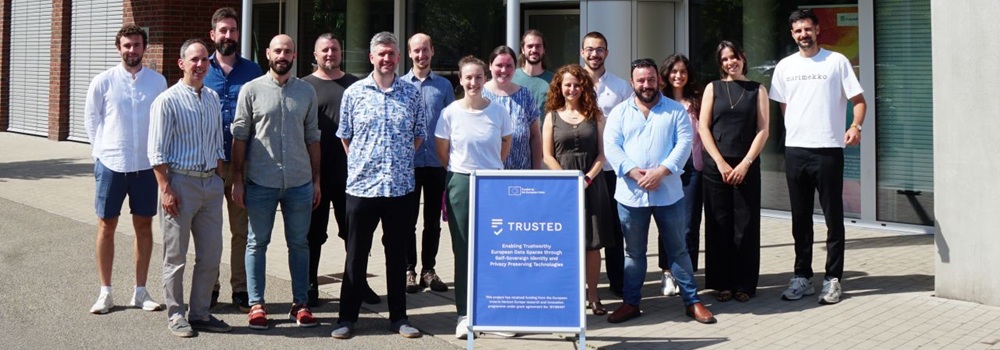
This week, the German city of Dortmund hosted the fourth in-person meeting of the consortium, where partners validated the results obtained during the first phase and will define the next steps for TrustED’s technological evolution.
The TRUSTED partners are: Gradiant, as coordinator; Tree Technology and Fundación Cibervoluntarios, from Spain; InfoCert SPA and CyberSocial Lab, from Italy; Fraunhofer, through two different departments, AISEC and ISST, from Germany; Promptly and Centro Hospitalar Universitário de Coimbra, from Portugal; Sestek, from Turkey; and Fondazione Mondo Digitale, as an associated entity.
TRUSTED project has received funding from the European Union’s Horizon Europe research and innovation programme under agreement no. 101168467.