Galician RTOS secured over 33 million euros in funding from national and regional R&D&I programmes in 2025
GRADIANT, AIMEN, ANFACO-CYTMA, CETIM, CTAG and ITG secured €18.3 million in national funding schemes run by the CDTI, plus a further €15 million from schemes managed by the Galician Innovation Agency
Research Technology Organizations within ATIGA have also, in just five years, surpassed the total European funding secured in the previous seven years, having secured over 50 million euros from Horizon Europe between 2021 and 2025
In 2025, the research technology organizations forming part of the Galician Cross-Sectoral Technology Alliance (ATIGA) consolidated their position as one of the main drivers of R&D&I in Galicia after securing over 33 million euros in competitive funding schemes at national and regional level, thereby strengthening their capacity for technology transfer, business collaboration and the promotion of strategic projects for Galicia.
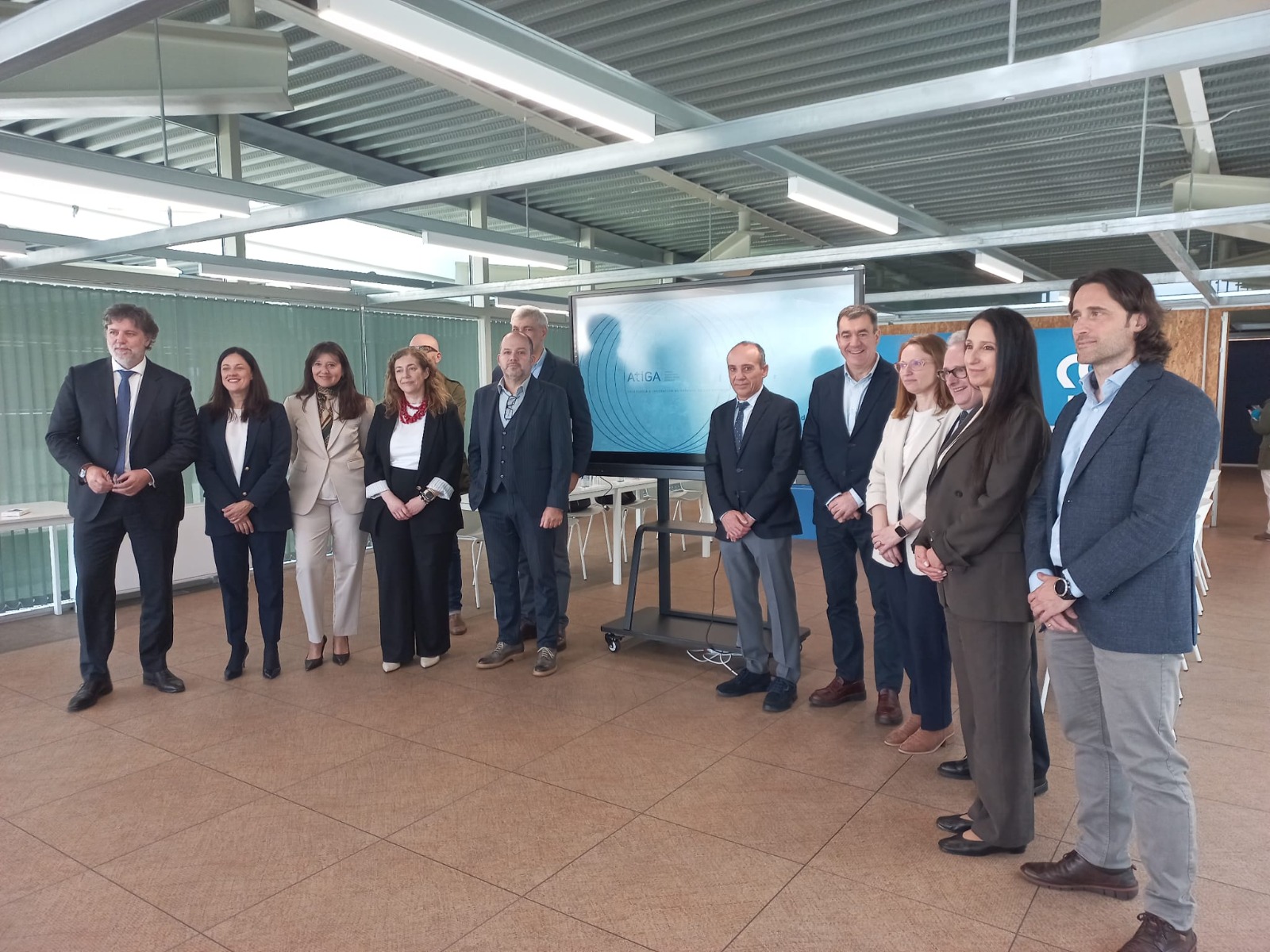
The data was analysed this morning in Santiago during a meeting between the Regional Minister for Education, Science, Universities and Vocational Training, Román Rodríguez; the Director of the Galician Innovation Agency, Carmen Cotelo; and representatives of the Galician research teechnology organizations forming part of ATIGA: GRADIANT, AIMEN, ANFACO-CYTMA, CETIM, CTAG and ITG.
Among the key results achieved by the centres, the securing of 10.3 million euros under the CDTI’s Cervera Programme stands out in particular, placing Galicia as the third-ranked autonomous community in terms of funding secured in this call for proposals, which aims to foster collaboration between Spanish technology centres. This figure is also three times that obtained in the previous edition.
Under the Cervera programme, Galician organizations spearheaded ten strategic projects in high-impact fields, such as dual-use technologies for defence, artificial intelligence applied to security, quantum computing, advanced materials, smart energy systems and omics technologies for the development of functional foods. One of these projects also received the highest rating at national level.
In addition to these figures, there are a further 8 million euros linked to projects under the CDTI’s Misiones and Interconecta STEP programmes, and at regional level, 6 million euros for strengthening scientific and technological infrastructure, 2.5 million euros for promoting new Joint Research Units (UMI), mobilising projects worth 12 million euros, 1 million euros for the Nexos programme with Galician companies (primarily SMEs) and a further 5.4 million euros in grants for the consolidation and structuring of competitive research units, reinforcing the role of the organizations as strategic partners of Galician industry and key agents of technology transfer.
Growing leadership in Europe
The strength demonstrated by Galician research technology organizations in national and regional programmes is further complemented by an increasingly solid position in Europe.
Between 2021 and 2025, the organisations within ATIGA secured over 50 million euros in Horizon Europe funding, already exceeding the funding obtained throughout the entire Horizon 2020 period (2014–2020).
In this context, Galician research technology organizations are also strengthening their relative weight within the regional ecosystem. Whilst in Horizon 2020 they accounted for 23.1% of all European funding secured by Galicia, in Horizon Europe this figure has now risen to 26.6%, consolidating their position as one of the main drivers of internationalisation and technology transfer in the region.
Economic impact and transfer to the productive sector
The Research Technology Organizations that make up ATIGA —GRADIANT, AIMEN, ANFACO-CYTMA, CETIM, CTAG and ITG— employ around 1,900 professionals of 36 nationalities and carry out more than 500 R&D&I projects each year.
In 2025, the organizations published 123 job vacancies and maintained high levels of job stability, with 98% of contracts being permanent. Furthermore, 64% of staff have been with the organisation for more than three years and 45% of staff are women.
In the technological sphere, the centres hold 175 active patents and continue to expand their collaboration with the business sector, reaching nearly 2,000 clients and reinforcing their role as key agents for knowledge transfer and industrial innovation in Galicia.
From an economic perspective, the organizations generate a combined revenue of 117.8 million euros, underpinned by a model based on business collaboration and participation in competitive regional, national and international programmes.
According to a report recently published by the Federation of Spanish Technology Centres (FEDIT) and the Valencian Institute of Economic Research (IVIE): “Taking into account the operating costs of the Research Technology Organizations within FEDIT and their impact on the economy, it can be concluded that for every euro spent on these operating costs, 11.0 euros of income and 26.4 euros of sales are generated. And for every million euros spent on operating costs, 181 jobs are created or maintained. These figures highlight the significant multiplier effect of the Research Technology Organizations’ activities in economic terms.”
Román Rodríguez: “Galicia is proud to have this network of research technology organizations”
During the meeting, the Regional Minister for Education, Science, Universities and Vocational Training, Román Rodríguez, highlighted the strategic role of Galician research technology organizations within the region’s innovation ecosystem and stated that “Galicia is proud to have this network of organizations”.
Rodríguez highlighted the ability of the organisations within ATIGA to secure European funding, create skilled jobs and serve as a model of public-private collaboration. In this regard, he emphasised that research technology organizations are “a basic and fundamental support for the region’s most strategic economic sectors” and particularly highlighted their “ability to connect research, business and technology transfer, turning ideas and knowledge into processes and products with a real impact”.
The regional minister also stressed the importance of continuing to make progress in areas such as attracting projects, creating jobs and developing new innovative initiatives that will strengthen the competitiveness of Galicia’s productive sector.
Jesús Lago: “Our job is to help Galician companies operate and compete with the best in Europe”
For his part, the president of ATIGA, Jesús Lago, highlighted that 2025 was “a very busy year” for research technology organizations and recalled that their main mission is “to help Galician companies work and compete with the best in Europe” through R&D&I projects and services, “many of which are international in nature”.
He also highlighted the capacity of Galician research technology organizations to develop technologies applicable to strategic sectors such as food, transport and aeronautics, as well as their work in cutting-edge fields such as quantum computing, robotics and artificial intelligence, “to serve the entire productive sector”.
Gradiant, one of ATIGA’s leading success stories in 2025
Gradiant leads Blossom, the first and only EIC Pathfinder Open project coordinated by a Galician research technology organization.
The Gradiant research technology organization coordinates Blossom, a project funded by the European Innovation Council (EIC) Pathfinder Open programme, with a total budget of 2.99 million euros, 100% funded by the European Commission.
The consortium brings together organisations from Spain, Poland, Ireland and Portugal and comprises a team of 25 researchers specialising in photonic technologies.
The project focuses on the design of autonomous, ultra-efficient, low-power photonic systems with direct applications in artificial intelligence, telecommunications and the aerospace sector.
The solutions developed are particularly relevant for extreme environments where energy supply is unfeasible.
Blossom’s leadership strengthens Gradiant’s capacity to coordinate highly complex European projects, drives new lines of research at the centre and helps attract and retain qualified talent. It also consolidates the international positioning of the Galician R&D&I ecosystem in disruptive technologies and opens up opportunities for technology transfer, including the generation of patents.