Synthetic data and small language models: Gradiant takes on two new AI challenges at IberLEF 2026
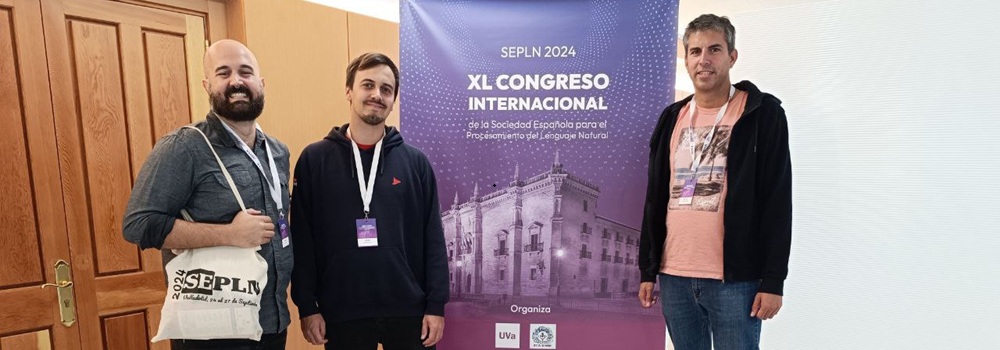
The technology centre’s team takes first place in REST-MEX 2026 with an approach based on synthetic data generation using smaller language models
The work presented in REST-MEX and GenSIE shows that process design, architecture and data quality can be just as decisive as model size
Gradiant is participating in IberLEF 2026, which will take place on 22 September as part of the SEPLN 2026 Conference in León, with two research papers focused on the use of smaller language models to address complex artificial intelligence tasks. The technology centre’s team has worked on synthetic data generation and structured information extraction, achieving notable results such as first place in the REST-MEX 2026 challenge.
IberLEF is an annual evaluation campaign for Natural Language Processing (NLP) systems in Spanish and other Iberian languages. Each edition brings together shared tasks in which research teams compare methods, results and lessons learned. The work is presented at the annual conference of the Spanish Society for Natural Language Processing (SEPLN).
Over the years, these tasks have addressed issues such as detecting harmful online content, automatically adapting texts into easy-to-read formats, creating corpora for health and social care contexts, and sentiment analysis. The evolution of generative artificial intelligence has introduced new challenges: detecting AI-generated text, verifying the traceability of responses, and assessing how far smaller models can go.
This year, a Gradiant team made up of Anthea Silvia Sasdelli, David Sueiro, Álvaro Bueno, Alberto Vilches, Sindy Rocío Mojica, Pedro Alonso and Héctor Cerezo is taking part in IberLEF with two papers: REST-MEX and GenSIE.
Our experience at IberLEF with emerging language technologies
Gradiant has participated in IberLEF since 2024, when the team presented Telescope, a system for detecting artificially generated text that ranked third among more than 50 participants in IberAuTexTification.
In 2025, the team went on to achieve third place in PRESTA, a question-answering task involving tables in Spanish. Our system combined language models, Python code generation and a multi-step process to analyse the tables and retrieve the answer. The method achieved 85% accuracy on the test data. The full paper can be consulted in the IberLEF 2025 proceedings.
Gradiant also has experience in similar international workshops such as SemEval 2025, where Álvaro Bueno presented in Vienna a paper on question answering over tabular information. This work later evolved into the approach presented at IberLEF, although the SemEval task covered multiple languages rather than Spanish alone.
In 2026, our team will tackle two new challenges: REST-MEX, focused on creating a synthetic dataset to train a classifier for tourism reviews, and GenSIE, which examines the use of small language models to extract structured information from text. In both cases, scientific papers will be presented and included in the IberLEF 2026 proceedings.
REST-MEX: synthetic data that sounds human
The REST-MEX 2026 challenge involves generating synthetic tourism reviews about Mexico’s Pueblos Mágicos (or “Magical Towns”). The dataset must contain no more than 3,000 texts, distributed across five rating categories (from one to five stars), and must be used to train a model capable of classifying new reviews.
Pedro Alonso, Senior Research Engineer at Gradiant, explains what the challenge involves and why it is complex:
“The difficulty does not lie simply in producing grammatically correct sentences. For the dataset to be useful, the reviews must cover a wide range of experiences, use diverse vocabulary and reflect different ways of expressing oneself across the Spanish-speaking world. They must also maintain a coherent relationship between the traveller profile, the itinerary and the assigned rating.
Our system starts from fictional traveller profiles and simulated itineraries. Using this information, it generates reviews similar to those a person might write after a trip. The process is divided into two main stages:
- Large-scale generation. We create a broad set of reviews using exclusively open-source language models with 4B and 7B parameters. These models are much lighter than the large commercial alternatives.
- Diversity-based selection. We then apply filters based on semantic similarity to select the 3,000 texts that provide the most diverse and useful distribution for training the classifier.
The combination of different generators and filters resulted in several submissions. The best achieved first place, while four of our proposals ranked among the top five entries in REST-MEX 2026.”
This experience confirms a key idea: when generating synthetic data, model size is not everything. Careful process design, coherent simulation of the content to be generated and an effective filtering strategy can turn lighter models into powerful tools for creating high-quality datasets.
GenSIE: extracting complex information with smaller models
GenSIE raises a different question: can small language models extract structured information with accuracy close to that of larger models if the workflow is properly designed?
In each test, the system receives a text and an output schema containing the fields it needs to complete. David Sueiro, Research Engineer at Gradiant, explains where the difficulty lies:
“The response has to follow a predefined structure (for example, a JSON object containing entities, relationships or nested lists), even if the model has not been specifically trained for that format.
To address the challenge, we developed three strategies:
- Stable workflow. This divides the task into several calls to the model. It first identifies the relevant entities, then highlights that information in the text and, finally, extracts and verifies the response. This sequence helps reduce hallucinations and was the best-performing strategy among our proposals.
- Experimental workflow. This classifies the fields in the schema according to their semantic nature and assigns a specific extraction technique to each category. Some fields can be resolved through a direct question, while others require choosing between several options or reconstructing more complex structures.
- Constrained workflow. This incorporates an adjustable reasoning mode and adaptive time management to complete each task within the 60-second limit. The aim is to allocate greater computational capacity to more difficult cases without exceeding the competition’s constraints.
The final GenSIE 2026 ranking placed Gradiant in eighth position. Although we did not reach the top positions, the challenge enabled us to identify several useful lessons. The stable workflow was the most competitive of our approaches.”
The main conclusion is that model size is only one part of the equation. The way a problem is broken down, instructions are formulated, relevant information is highlighted and outputs are verified can help narrow the gap between smaller and larger models.
At the same time, working with different models requires robust architectures: a configuration that works effectively for one model may not perform in the same way with another.
What have we learned from this experience?
- Data quality is designed. Generating a large number of examples is only the first step; selecting the most diverse and coherent ones determines their real usefulness.
- Modular processes provide greater control. Breaking a complex task into stages makes verification, traceability and error detection easier.
- A larger model is not necessarily a substitute for good architecture. The design of instructions, filters and verification mechanisms can be just as important as the number of parameters.
On 22 September, Gradiant will present this work at the IberLEF workshop, held as part of the SEPLN 2026 Conference in León, which runs until 25 September. It will be an opportunity to share results, compare approaches with the research community and continue improving language technologies that are more efficient, controllable and useful.